WPC ETA Certification is the approval issued by the Wireless Planning & Coordination Wing for wireless products operating in licence-free frequency bands. It confirms RF compliance before the product can be sold or imported in India.

WPC ETA Approval certification issued by the Wireless Planning & Coordination (WPC) Wing of the Department of Telecommunications (DoT), Government of India. It's the official confirmation that your wireless device operates within India's allocated, de-licensed frequency bands and won't cause interference with the country's telecom networks.
India's radio spectrum is a shared national resource. Licensed operators — mobile networks, aviation, emergency services, defence — use specific parts of it. Products like your Bluetooth headset or Wi-Fi router use other parts (the "de-licensed" bands like 2.4 GHz and 5 GHz) that are open to everyone, but only within strict technical limits. ETA certification is how the government verifies your device stays within those limits before it enters the market.
The WPC has been operating as India's national radio regulatory authority since 1952, long before consumer wireless products existed. Today it handles Equipment Type Approvals, import licensing for wireless devices, and spectrum management for the entire country.
What ETA actually confirms:Without ETA certification, your product cannot legally be imported into India, sold on Amazon India or Flipkart, distributed through retail channels, or used in commercial operations.
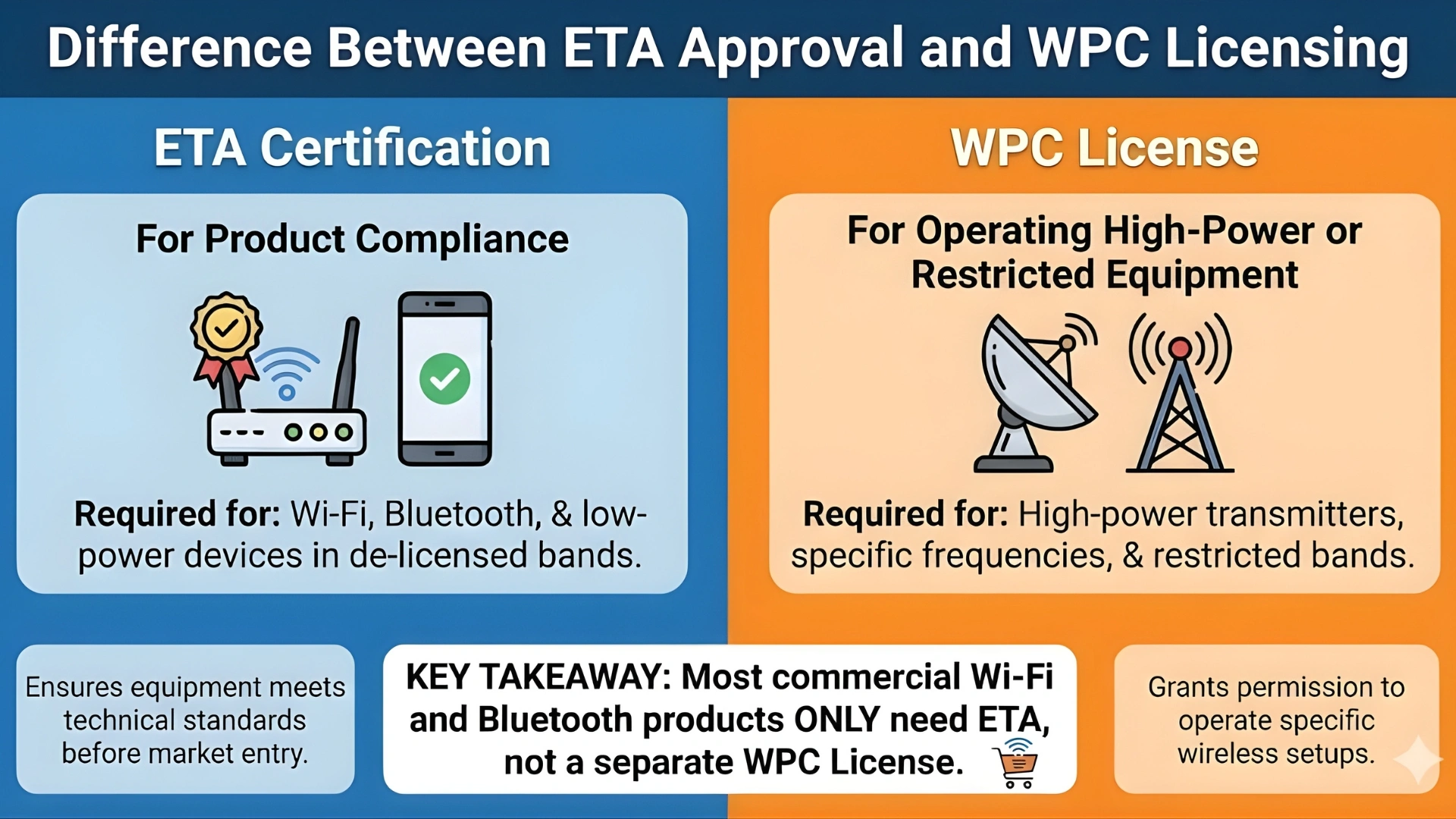
These two terms often get confused, so let's clarify them upfront.
ETA (Equipment Type Approval) is what most businesses need. It's the product-level certification for wireless devices that operate in de-licensed frequency bands — the 2.4 GHz Wi-Fi router, the Bluetooth speaker, the RFID inventory scanner. If you're importing or selling a consumer or commercial wireless product, ETA is your requirement.
WPC License is different. It's for entities that want to operate wireless communication services or use high-power / restricted-band equipment — broadcasters, telecom operators, industrial wireless operators. Most product importers and manufacturers never need a WPC License; they just need the ETA.
There's also a separate Import License that some importers require after the ETA is granted, depending on the product category and import volume. We cover this in the process section below.
If there is one document that decides whether your WPC ETA application succeeds or fails, it is the RF Test Report. Without it, you cannot even file your application. With a poorly prepared one, your application will be rejected — and you'll have to restart the testing process from scratch, adding weeks and cost.
An RF (Radio Frequency) Test Report is a formal technical document produced by an accredited laboratory after physically measuring your product's wireless transmission characteristics. The lab uses spectrum analysers, signal generators, calibrated antennas, and shielded test chambers to measure exactly how your device transmits radio signals — and whether those transmissions stay within the limits WPC requires.
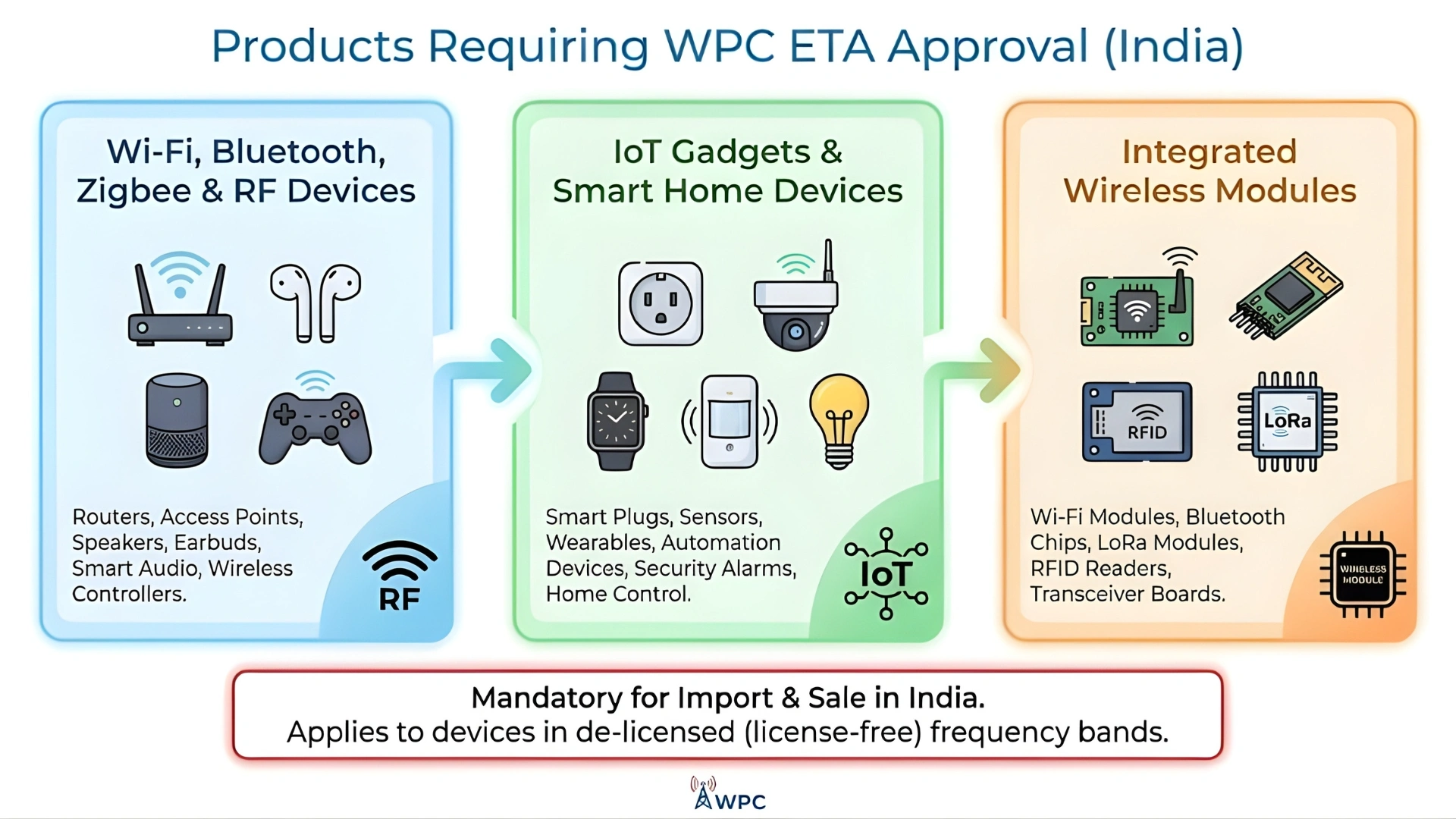
ETA is mandatory because India strictly regulates how wireless devices use radio frequencies. Every Wi-Fi, Bluetooth, RFID, Zigbee, LoRa, or RF-enabled product must prove that it operates only in approved licence-free frequency bands and does not interfere with critical communication networks.
The key reasons include:If your product uses Bluetooth, Wi-Fi, RFID, ZigBee, NFC, or any radio frequency technology — and you plan to import, manufacture, or sell it in India — you are legally required to obtain WPC ETA Approval before the product enters the Indian market. There are no exceptions. Skipping this step means your shipment can be seized at customs before it ever reaches a warehouse.
WPC stands for Wireless Planning and Coordination Wing. It operates under the Department of Telecommunications (DoT), Government of India, and has served as India's national radio regulatory authority since 1952. The ETA — or Equipment Type Approval — is the formal certification that the WPC issues to confirm your wireless device operates strictly within India's allocated, de-licensed frequency bands and does not interfere with other communication networks.
The WPC was established to manage India's radio frequency spectrum — a finite national resource. By requiring all wireless products to undergo Equipment Type Approval, the government ensures that every device sold in India operates within prescribed frequency limits, preventing harmful interference with telecom networks, emergency services, and other critical communication infrastructure.
WPC Approval includes two main components:In simple terms, WPC Approval is the mandatory regulatory permission that makes wireless devices legal and safe to use in the Indian market.
| Category | Common Subtypes / Licences / Approvals |
|---|---|
| Equipment Authorisation | Equipment Type Approval (ETA) — for wireless / RF products operating in “de-licensed (license-free)” frequency bands. |
| Import-related Licence | Import Licence — for importing wireless / radio equipment into India, even after ETA. |
| Possession / Distribution Licences (Non-Network) | Dealer Possession Licence (DPL) — for dealers/distributors of wireless equipment; Non-Dealer Possession Licence (NDPL) — for non-network entities holding/using wireless devices. |
| Network / Service-Provider Licences | For entities providing wireless communication services (e.g. ISPs, telecom operators, service-providers) using licensed or special frequency bands. |
| Experimental / Trial Licence | For testing, research or demonstration of wireless equipment or radio frequency setups (e.g. during R&D, trials, prototype testing). |
WPC ETA certification is mandatory for a wide range of stakeholders across the wireless product supply chain. Understanding where you fall is the first step to getting compliant.
| Stakeholders | Requirements | Key Note |
|---|---|---|
| Foreign Manufacturers | Must obtain ETA via an Authorized Indian Representative (AIR) | Cannot apply directly — AIR is mandatory |
| Indian Manufacturers | Can apply for WPC ETA directly through Saral Sanchar | No AIR needed if branch office exists in India |
| Importers & Traders | Must hold valid ETA certificate before importing wireless devices | Customs requires ETA at point of entry |
| Distributors & Retailers | Must only stock and sell ETA-certified products | Possession of non-compliant devices invites enforcement |
| Startups & D2C Brands | Required before product launch or e-commerce listing | Platforms increasingly verify compliance at onboarding |
| E-commerce Sellers | Must attach ETA certificate to listings involving wireless products | Amazon India, Flipkart routinely audit compliance |
One important nuance for manufacturers: If a product is manufactured in India and the RF module already holds its own valid ETA — and has been installed without any modification — no separate ETA is required for the finished product. However, any product manufactured outside India requires its own ETA before import, regardless of whether the RF module is certified in the USA, EU, or elsewhere.
Before applying for WPC ETA certification, your product and business must meet these fundamental requirements set by the Wireless Planning and Coordination (WPC) Wing, Department of Telecommunications, Government of India.
Not every entity can directly apply for WPC ETA Approval. The WPC has defined clear eligibility rules that determine who can apply, in what capacity, and under what conditions. Understanding these criteria before initiating the process saves time, prevents rejections, and ensures your application is submitted through the correct legal route.
The following categories of entities registered in India are eligible to file a WPC ETA application directly through the Saral Sanchar Portal without requiring an Authorized Indian Representative:
Foreign manufacturers, brands, and entities that do not have a registered legal presence in India are not eligible to apply for WPC ETA directly. They must mandatorily appoint an Authorized Indian Representative (AIR) to act on their behalf. The AIR submits the application, holds the certificate, and bears legal responsibility for compliance in India.
| Entity Type | Certificate Issued To |
|---|---|
| Indian Pvt. Ltd. / Public Ltd. Company | The Indian Company |
| Indian LLP / Partnership Firm | The Indian Entity |
| Indian Sole Proprietorship | The Proprietor / Firm |
| Indian Subsidiary of Foreign Company | The Indian Subsidiary |
| Branch / Liaison Office (RBI Registered) | The Branch Office |
| Foreign Manufacturer (No India Presence) | The Appointed Indian AIR |
| Foreign Brand / Exporter (No India Entity) | The Appointed Indian AIR |
| Individual Foreign National | The Appointed Indian AIR |
Beyond entity eligibility, the product itself must satisfy specific technical and regulatory conditions to qualify for WPC ETA Approval under the de-licensed band framework. Products that do not meet these conditions may require a different approval type or may need hardware modifications before they can be certified for the Indian market.
| Eligibility Condition | Explanation |
|---|---|
| Operates on De-licensed Frequency Bands | Product must use frequencies within India's de-licensed band spectrum (e.g., 2.4GHz, 5GHz, 865–867MHz for RFID). Products on licensed bands require a separate ETA route. |
| Output Power Within Permissible Limits | The radiated power must not exceed the power limits prescribed by WPC for the specific frequency band in use. Exceeding limits disqualifies the product from de-licensed ETA. |
| No Intentional Interference Capability | The device must not be capable of causing harmful interference to licensed telecom services, emergency frequencies, or aviation/maritime communication bands. |
| Wireless Module is NABL/ILAC Tested | RF test report must be from an accredited lab. Products without a valid, accredited test report are ineligible for ETA grant regardless of other conditions. |
| Product is Commercially Defined & Fixed | The product design, model number, and RF specifications must be finalised. Applications for prototypes undergoing design changes cannot be processed. |
| Applicant Holds Valid Business Registration | The applying entity must have active, valid business registration. Dissolved, deregistered, or blacklisted entities are ineligible. |
| No Previous ETA Rejection for Same Model | If a previous application for the identical model was rejected due to technical non-compliance, the product must be retested and resubmitted — not simply re-filed. |
A simplified Self-Declaration route is available for applicants whose products satisfy both of the following conditions simultaneously. Missing either condition removes eligibility for this faster track:
Products meeting both conditions may submit a Self-Declaration in lieu of a full ETA application, significantly reducing processing time to 7–14 working days. However, the applicant assumes full legal responsibility for ensuring compliance with the de-licensed band specifications through this route.
If there is one document that stands at the absolute centre of every WPC ETA application — one that WPC officials scrutinise more closely than anything else you submit — it is the RF Test Report. Without it, your application cannot even begin. With a poorly prepared one, your application will be rejected or delayed indefinitely. Understanding exactly what it is, what it must contain, and why WPC treats it as the foundation of its entire review process is critical knowledge for every importer, manufacturer, and brand seeking approval for wireless products in India.
An RF Test Report — short for Radio Frequency Test Report — is a formal technical document produced by an accredited laboratory after scientifically testing a wireless product's radio transmission characteristics. In plain language, it is the laboratory's written proof that your product's wireless signals behave exactly as they should — operating within the correct frequency bands, at the correct power levels, without leaking interference into adjacent parts of the radio spectrum.
The laboratory physically tests your product sample using specialised RF measurement equipment — spectrum analysers, signal generators, antennas, shielded test chambers (anechoic chambers or shielded rooms) — and records every measurable characteristic of how your device transmits and receives radio signals. The resulting document is the RF Test Report: a comprehensive, signed, laboratory-certified record of those measurements and whether they comply with applicable technical standards.
The
WPC ETA approval exists for one fundamental purpose: to ensure that wireless devices sold in India operate only within designated, de-licensed frequency bands and do not cause harmful interference to India's broader radio communication ecosystem — which includes mobile networks, emergency services, aviation communication, satellite systems, and thousands of other licensed users of the radio spectrum.
| Without RF Test Report | With a Valid RF Test Report |
|---|---|
| WPC ETA application cannot be filed | Application accepted for review on Saral Sanchar portal |
| No technical basis for approval decision | WPC reviewer has objective data to base approval decision on |
| Product legally cannot be imported | ETA certificate can be issued — import proceeds legally |
| Customs will hold or seize the shipment | Customs clears the consignment against verified ETA certificate |
| Business faces fines and penalties | Business operates in full regulatory compliance in India |
| No defence against non-compliance allegation | Laboratory evidence defends product against any compliance challenge |
Not every laboratory is qualified to produce an RF Test Report that WPC will accept. The laboratory must meet one of two specific accreditation standards — and this is a mandatory requirement, not a preference. Reports from non-accredited labs are rejected outright regardless of how technically thorough they appear.
| Lab Type | Accreditation Required | Location |
|---|---|---|
| Indian Laboratory | NABL (National Accreditation Board for Testing and Calibration Laboratories) accreditation under ISO/IEC 17025 | India |
| Foreign Laboratory | ILAC (International Laboratory Accreditation Cooperation) MRA-signatory accreditation under ISO/IEC 17025 | Outside India |
| Non-Accredited Lab | No recognised accreditation body | Anywhere |
| University / R&D Institute | Unless specifically NABL or ILAC accredited for the test scope | Anywhere |
| In-House Lab (Manufacturer) | Self-operated labs without NABL/ILAC accreditation | Anywhere |
NABL is India's national laboratory accreditation body, operating under the Department for Promotion of Industry and Internal Trade (DPIIT). ILAC is the international umbrella organisation whose MRA (Mutual Recognition Arrangement) members are accredited labs from over 100 countries. Most major international RF testing laboratories — including those in China, Taiwan, Germany, the UK, and the USA — hold ILAC MRA accreditation, meaning their test reports are accepted by WPC for the ETA process.
The completeness and accuracy of the RF Test Report's content is what WPC scrutinises most closely. A report that is technically sound but missing required parameters — or that contains internal inconsistencies — will generate a query or be rejected. Here is what every WPC-compliant RF Test Report must include:
| Required Parameter | What It Measures | Why WPC Requires It |
|---|---|---|
| Product Identification | Full product name, model number, brand, hardware version, and firmware version tested. Must exactly match the ETA application details. | Establishes that the tested sample is the exact product being certified — not a different version |
| Operating Frequency | The precise frequency or frequency range at which the device transmits. Measured in MHz or GHz with exact values, not ranges. | Confirms the device operates within India's permitted de-licensed frequency bands |
| Maximum Output Power | The peak RF power output of the device, measured both at the antenna port (conducted power) and as radiated power (EIRP — Equivalent Isotropically Radiated Power). | WPC sets strict EIRP limits per band. Exceeding these means the device causes unacceptable interference to other spectrum users |
| Occupied Bandwidth | The range of frequencies actually occupied by the device's signal during normal transmission. Shows how much spectrum the device uses. | Ensures the device stays within its allocated channel and doesn't bleed into adjacent frequency bands |
| Frequency Span & Sweep Time | Technical parameters of how the spectrum analyser captured the signal. Documents the measurement methodology. | Allows WPC reviewer to assess the credibility and completeness of the measurement methodology |
| Video Bandwidth & Resolution Bandwidth | The filter settings used during spectrum analysis. Affects how clearly signal details are resolved in the measurement. | Ensures measurements are precise enough to accurately determine compliance — coarse settings can miss violations |
| Spurious Emissions | Any unintended radio signals the device emits outside its intended frequency band. Measured across a wide frequency range. | Spurious emissions can interfere with licensed services. ITU Radio Regulations set strict limits that must be confirmed |
| Modulation Type | The wireless modulation technique used by the device — e.g., OFDM for Wi-Fi, GFSK for Bluetooth, ASK for RFID. | Confirms the device uses only approved modulation methods for the claimed wireless technology standard |
| Antenna Details | Type of antenna used during testing, its gain (in dBi), and connector type. If a directional antenna is used, its orientation must be documented. | Antenna gain directly affects EIRP. A high-gain antenna can push a low-power device over EIRP limits — WPC checks this |
| Test Standards Referenced | The specific Indian or international standards under which testing was conducted, cited with their full designation and version number. | Establishes that testing followed a recognised, reproducible methodology — not arbitrary measurements |
| Lab Accreditation Details | The laboratory's NABL or ILAC accreditation number, scope of accreditation, and accreditation validity period. | WPC verifies lab accreditation status. An expired or out-of-scope accreditation invalidates the report |
| Lab Authorised Signatory | Name, designation, and signature of the laboratory's authorised signatory certifying the test results. | Establishes accountability and authenticity of the test report as a certified laboratory document |
RF testing timelines vary depending on the complexity of the product, the wireless technologies involved, the laboratory's current workload, and whether samples need to be shipped internationally. Here is a general timeline reference:
| Product Type | Typical RF Testing Duration | Key Factor |
|---|---|---|
| Simple single-band device (e.g., BT earbuds) | 3–5 working days | Single module, standard tests |
| Dual-band Wi-Fi device (2.4GHz + 5GHz) | 5–7 working days | Two bands, more measurements |
| Multi-module product (Wi-Fi + BT + NFC) | 7–10 working days | Three separate test scopes |
| Industrial RFID equipment | 5–8 working days | Duty cycle, ERP, band limits |
| Drone / UAV with RC + FPV | 8–12 working days | Multiple bands, regulatory complexity |
| Sample shipping (international labs) | Add 5–10 days (transit) | Customs clearance at destination country |
Any device that transmits or receives radio frequency signals — even at low power — typically falls within the WPC's regulatory scope. Below is a comprehensive product reference. If your product appears in any of these categories, WPC ETA Approval is mandatory.
| Product Category | Common Examples | Frequency Technology |
|---|---|---|
| Consumer Electronics | Smartphones, tablets, laptops, smartwatches, smart TVs | Wi-Fi, Bluetooth, NFC |
| Audio & Wearables | Wireless earbuds, headphones, Bluetooth speakers, hearing aids | Bluetooth, RF |
| Networking Equipment | Wi-Fi routers, access points, mesh systems, wireless modems | Wi-Fi (2.4GHz / 5GHz / 6GHz) |
| IoT & Smart Home Devices | Smart bulbs, plugs, sensors, home automation hubs | ZigBee, Wi-Fi, Bluetooth, Z-Wave |
| Industrial Wireless | RFID readers, barcode scanners, telemetry equipment | RFID, RF Modules |
| Drones & UAVs | Consumer drones, FPV drones, delivery UAVs | Wi-Fi, Bluetooth, 2.4GHz RC |
| Remote-Controlled Devices | RC cars, boats, helicopters, remote controllers | RF (2.4GHz / 5.8GHz) |
| Medical & Healthcare | Wireless patient monitors, Bluetooth glucose meters | Bluetooth, Wi-Fi, RFID |
| Automotive Electronics | Wireless key fobs, TPMS sensors, in-car Wi-Fi | RF, Bluetooth, Wi-Fi |
| Security & Surveillance | Wireless cameras, alarms, smart doorbells, motion sensors | Wi-Fi, Zigbee, RF |
| Computers & Peripherals | Wireless keyboards, mice, webcams, USB Wi-Fi dongles | Bluetooth, Wi-Fi |
| Gaming Accessories | Wireless controllers, VR headsets, gaming headsets | Bluetooth, RF (2.4GHz) |
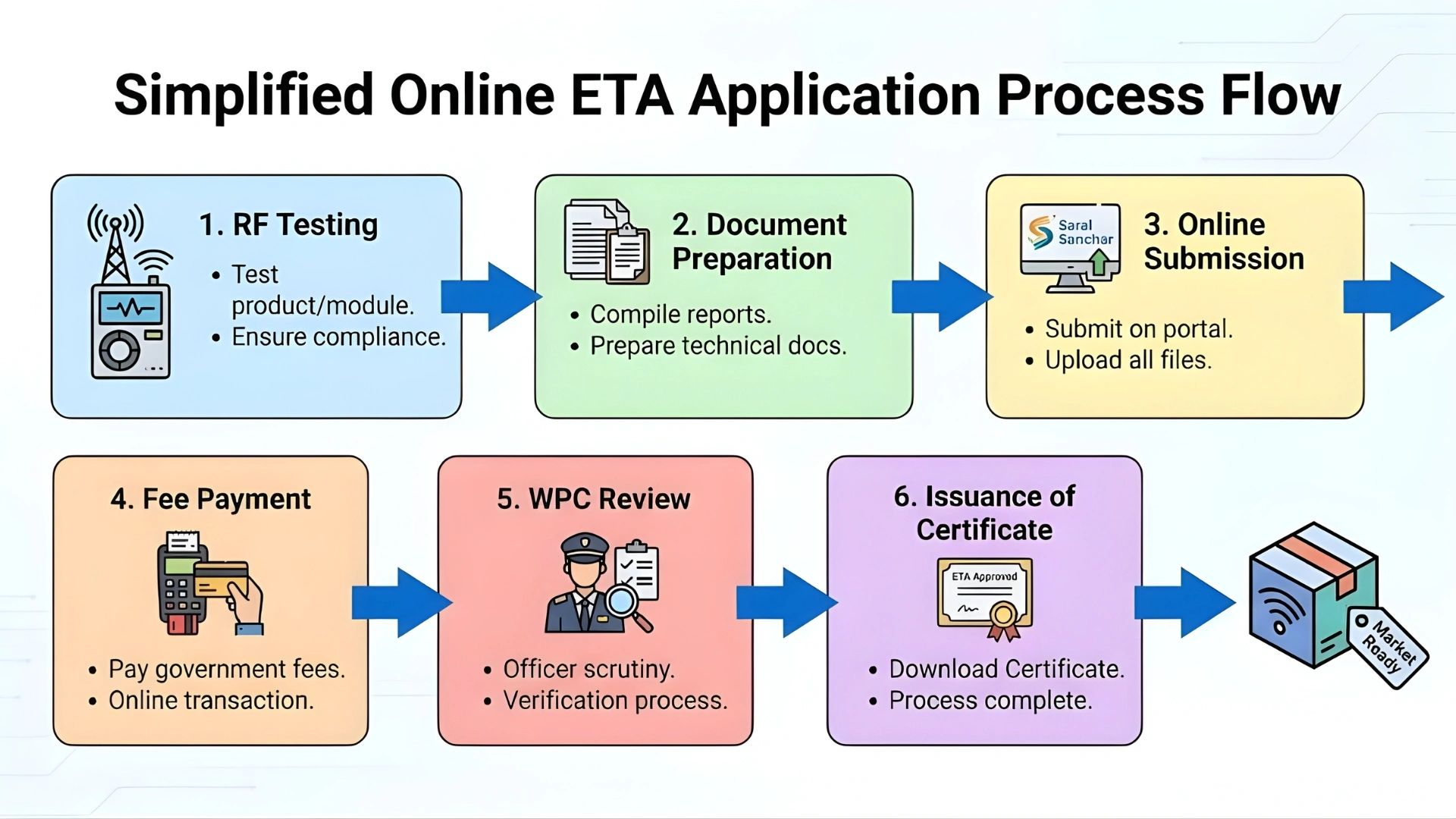
The WPC ETA process follows a defined sequence. Attempting to skip or reorder steps is one of the most common mistakes businesses make — particularly when they rush the RF testing phase. Here is the correct sequence:
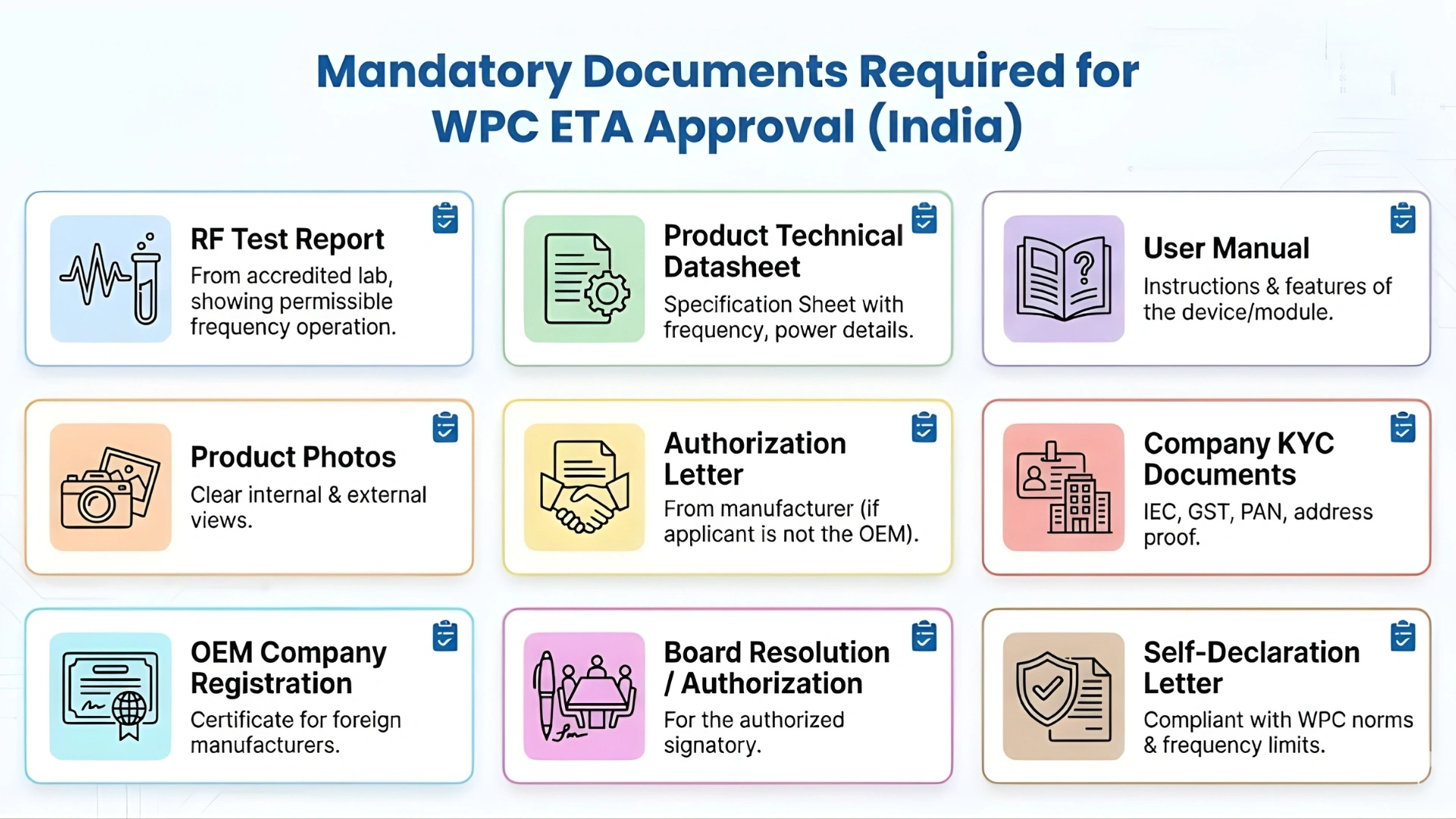
| Document | Details | Mandatory |
|---|---|---|
| RF Test Report | From NABL-accredited Indian lab or ILAC-accredited foreign lab. Must include frequency band, output power, video/resolution bandwidth, frequency span, sweep time. Each RF module needs its own report. | Yes — Critical |
| Company Registration Certificate | Business registration document of the applicant entity in India | Yes |
| GST Registration Certificate | Valid GST certificate of the applying entity | Yes |
| Import Export Code (IEC) | Mandatory for importers; issued by DGFT | Yes (for importers) |
| Authorization Letter (LOA) | Letter from foreign manufacturer authorizing the Indian AIR to apply on their behalf | Yes (foreign mfrs) |
| Product Datasheet | Complete technical specifications: model number, frequency bands, output power, antenna details | Yes |
| Wireless Technology Description | Detailed description of the wireless technology used — Bluetooth version, Wi-Fi standard, RFID frequency, etc. | Yes |
| Operating Instructions | User manual or product instructions confirming safe operation within Indian regulatory limits | Yes |
| Block Diagram / Circuit Diagram | RF circuit architecture and block diagram of the wireless module | Recommended |
| Self-Declaration Form | Manufacturer's declaration confirming compliance with WPC guidelines | Yes |
| Existing ETA Certificate | If the product contains a pre-approved RF module, the module's ETA must be submitted with a signed undertaking | Conditional |
| ID & Address Proof of AIR | Identity and address proof of the Authorized Indian Representative | Yes (foreign mfrs) |
The model number on your RF test report, product packaging, datasheet, and ETA application must match exactly — character for character. Any discrepancy between these documents is the most common cause of application rejection and customs flagging.
| Category | Details (Without Amount) |
|---|---|
| Government Fee | A fixed fee is payable through the official WPC Saral Sanchar portal at the time of ETA application submission. |
| RF Testing Cost | Depends on the accredited laboratory you select and the complexity of the wireless technology being tested. |
| Consultancy / Professional Charges | Varies based on service scope, documentation support, and filing assistance provided. |
| Total Project Cost | Includes government fee + RF testing + documentation/consultancy (if used). Exact cost depends on product type and testing requirements. |
| Standard Processing Timeline | Typically cleared within 7-15 working days when all documents and RF test reports are ready and correct. |
| Extended Timeline (If Testing Needed) | May take 4–5 weeks or longer when RF testing, clarification rounds, or corrections are required. |
| ETA Validity | ETA remains valid as long as the RF hardware, module, antenna, or PCB layout do not change. No regular renewal required. |
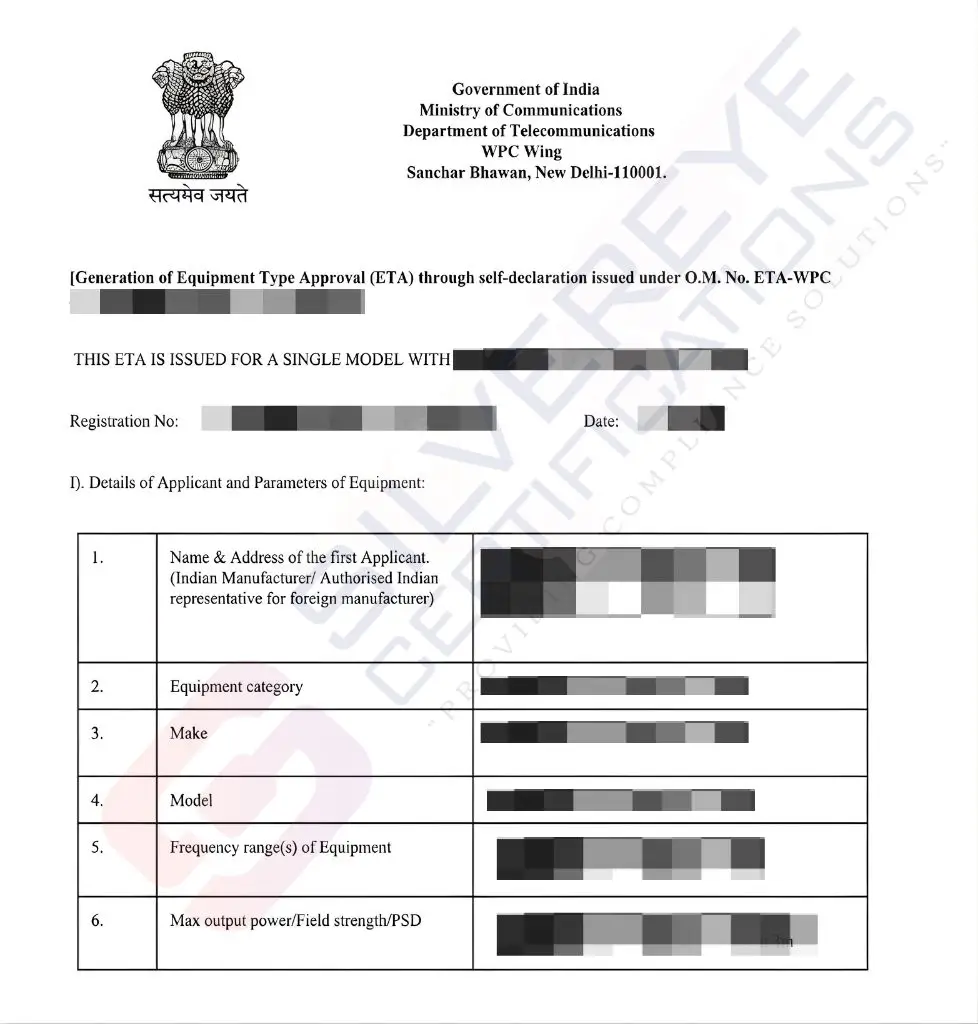
WPC ETA Certification does not have a fixed expiry date. Once issued, the certificate remains valid as long as the product’s RF hardware and technical configuration stay unchanged. This includes the antenna, chipset, frequency band, and PCB layout.
ETA renewal is not required under normal conditions because the certification is linked to the product's RF characteristics. Manufacturers and importers must keep the original ETA certificate, RF test report, and submission documents as proof of compliance for customs and market regulators.
A fresh ETA application becomes necessary if:
In summary, ETA renewal is only required when the wireless architecture of the product changes, ensuring it continues to comply with India’s spectrum rules.
The Saral Sanchar portal is publicly accessible and the process is theoretically self-manageable. In practice, however, WPC ETA applications submitted without expert guidance experience rejection rates nearly three times higher than those filed with professional support — primarily due to documentation errors, RF report formatting issues, and incorrect product classification.
| Challenge Without Expert Help | How a Consultant Solves It |
|---|---|
| Incorrect approval type selected | Classification verified against current WPC notifications before submission |
| RF test report format errors | Report pre-reviewed against WPC requirements before lab engagement |
| Consultancy / Professional Charges | Varies based on service scope, documentation support, and filing assistance provided. |
| AIR appointment procedural gaps (foreign mfrs) | Full AIR setup handled — including legal authorization documentation |
| Model number mismatches across documents | Cross-verification across all documents before filing |
| Query responses delayed or incorrect | Experienced consultants respond within WPC's query window — preventing rejection |
| Missed regulatory updates | Consultants track DoT notifications and advise proactively on changes |
| Import license oversight post-ETA | Commercial import license applied for in parallel where applicable |
Our end-to-end WPC ETA service covers everything: product classification, RF test lab coordination, complete document preparation, AIR appointment support for foreign manufacturers, Saral Sanchar portal submission, query handling, and certificate delivery. You focus on your business. We handle the compliance.
India's wireless product market is growing at a pace that rewards early movers — but only those who are compliant can participate fully. Whether you are an importer bringing your first shipment of Bluetooth speakers into India, a startup launching an IoT product line, or a global brand establishing Indian market presence, WPC ETA Approval is the non-negotiable first step.
Our team of experienced WPC compliance consultants has successfully managed ETA certifications across hundreds of product categories — from consumer wearables and smart home devices to industrial IoT equipment and connected medical devices. We know what WPC reviewers look for, we know how to preempt queries, and we know how to get your certification done right, the first time.






























































WPC ETA Certification is the approval issued by the Wireless Planning & Coordination Wing for wireless products operating in licence-free frequency bands. It confirms RF compliance before the product can be sold or imported in India.
Any manufacturer, importer, or brand dealing with Wi-Fi, Bluetooth, RFID, Zigbee, or IoT-based products must obtain ETA approval before entering the Indian market.
Yes. If a device uses radio frequency transmission—even at low power—it requires ETA approval unless it operates in exempt categories defined by DoT.
If the RF module is ETA-certified and used without altering its antenna or RF characteristics, a fresh ETA may not be required. Any hardware change will need new certification.
An RF Test Report, product technical details, internal/external photographs, authorization letters, and applicant identification documents are typically required.
Most applications are cleared within 2–3 weeks when all documents and RF test results are ready and accurate. Testing requirements may extend the timeline.
Indian manufacturers, importers, and authorized representatives of foreign brands can apply through the Saral Sanchar portal.
Yes. A valid RF Test Report from an accredited laboratory is the foundation of the ETA process and is required for WPC evaluation.
ETA remains valid indefinitely unless the product’s wireless hardware, antenna, chipset, or PCB design is changed.
Yes. Silvereye Certifications handles RF testing coordination, documentation, portal filing, and WPC communication to ensure smooth and timely ETA approval.